🇸🇬 Singapore
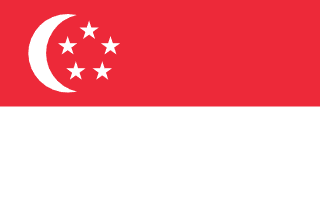 National Flag
Geography & Borders
This country has no land borders.
Introduction & Background
Singapore (/ˈsɪŋ(ɡ)əpɔːr/ⓘ), officially the Republic of Singapore, is a sovereign island country and city-state in maritime Southeast Asia. It lies about one degree of latitude (137 kilometres or 85 miles) north of the equator, off the southern tip of the Malay Peninsula, bordering the Strait of Malacca to the west, the Singapore Strait to the south, the South China Sea to the east, and the Straits of Johor to the north. The country's territory is composed of one main island, 63 satellite islands and islets, and one outlying islet; the combined area of these has increased by 25% since the country's independence as a result of extensive land reclamation projects. It has the third highest population density in the world. With a multicultural population and recognising the need to respect cultural identities of the major ethnic groups within the nation, Singapore has four official languages: English, Malay, Mandarin, and Tamil. English is the lingua franca and numerous public services are available only in English. Multiracialism is enshrined in the constitution and continues to shape national policies in education, housing, and politics.
Singapore's history dates back at least a millennium, having been a maritime emporium known as Temasek and subsequently as a major constituent part of several successive thalassocratic empires. Its contemporary era began in 1819 when Stamford Raffles established Singapore as an entrepôt trading post of the British Empire. In 1867, the colonies in Southeast Asia were reorganised and Singapore came under the direct control of Britain as part of the Straits Settlements. During World War II, Singapore was occupied by Japan in 1942, and returned to British control as a separate Crown colony following Japan's surrender in 1945. Singapore gained self-governance in 1959 and in 1963 became part of the new federation of Malaysia, alongside Malaya, North Borneo, and Sarawak. Ideological differences, most notably the perceived encroachment of the egalitarian "Malaysian Malaysia" political ideology led by Lee Kuan Yew into the other constituent entities of Malaysia—at the perceived expense of the bumiputera and the policies of Ketuanan Melayu—eventually led to Singapore's expulsion from the federation two years later; Singapore became an independent sovereign country in 1965.
Geography & Climate
Temperature (2025)
Precipitation & Snow (2025)
Atmospheric Pressure (2025)
Thunderstorm Days (2025)
Wind Speed (2025)
Air Quality — Monthly Averages (2025)
| Metric | Jan | Feb | Mar | Apr | May | Jun | Jul | Aug | Sep | Oct | Nov | Dec |
|---|---|---|---|---|---|---|---|---|---|---|---|---|
| PM2.5 μg/m³ | 15.4 | 18.3 | 26.9 | 23.1 | 23.3 | 18.9 | 17.9 | 16.1 | 17.3 | 19.4 | 16.7 | 16.4 |
| PM10 μg/m³ | 17.9 | 21.3 | 29.6 | 24.1 | 24.6 | 20.3 | 18.8 | 16.9 | 17.9 | 20.4 | 17.4 | 18.2 |
| O₃ μg/m³ | 51.9 | 49.9 | 47.5 | 38.8 | 40.5 | 49.5 | 53.4 | 47.3 | 43.2 | 49.2 | 52.5 | 44.3 |
| NO₂ μg/m³ | 34.4 | 39.7 | 48 | 57.1 | 56.7 | 38.6 | 36.4 | 36.7 | 39.3 | 46.3 | 41.5 | 39.5 |
| SO₂ μg/m³ | 16.1 | 19.1 | 24 | 34.6 | 40 | 23.9 | 19.6 | 21.8 | 24.2 | 30 | 26.9 | 23.9 |
| CO μg/m³ | 239 | 251 | 266 | 249 | 229 | 169 | 167 | 177 | 185 | 189 | 215 | 198 |
Pollen Levels — Monthly (2025)
⛰️ Highest Elevation
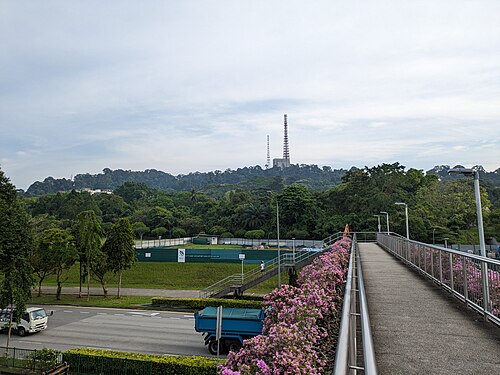
- Map Locations: Google Maps | OpenStreetMap