🇹🇳 Tunisia
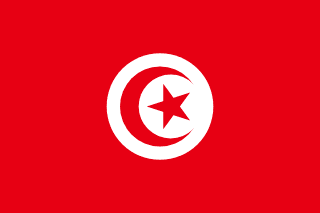 National Flag
Geography & Borders


Introduction & Background
Tunisia,a officially the Republic of Tunisia,b18 is the northernmost country in Africa. It is a part of the Maghreb region of North Africa, bordered by Algeria to the west and southwest, Libya to the southeast, and the Mediterranean Sea to the north and east. It features the archaeological sites of Carthage dating back to the 9th century BC, as well as the Great Mosque of Kairouan. Known for its ancient architecture, souks and blue coasts, it covers 163,610km2 (63,170sqmi), and has a population of 12.1 million. It contains the eastern end of the Atlas Mountains and the northern reaches of the Sahara desert; much of its remaining territory is arable land. Its 1,300km (810mi) of coastline include the African conjunction of the western and eastern parts of the Mediterranean Basin. Tunisia is home to Africa's northernmost point, Cape Angela; and its capital and largest city is Tunis, which is located on its northeastern coast, and lends the country its name.
Beginning in early antiquity, Tunisia was inhabited by the indigenous Imazighen. Phoenicians began to arrive in the 12th century BC, establishing several settlements, of which Carthage emerged as the most powerful by the 7th century BC. Carthage was a major mercantile empire and a military rival to the Roman Republic until 146 BC, when it was defeated by the Romans who occupied Tunisia for most of the next 800 years. The Romans introduced Christianity and left architectural legacies like the Amphitheatre of El Jem. In the 7th century AD, Muslims conquered all of Tunisia (finally succeeding in 697 after several attempts starting in 647), and they brought Islam and Arab culture to the local inhabitants. Then, in 1546, the Ottoman Empire established control there, holding sway for over 300 years, until 1881, when the French conquered Tunisia. In 1956, Tunisia gained independence as the Tunisian Republic under the leadership of Habib Bourguiba with the help of activists such as Chedly Kallala, Farhat Hached and Salah ben Youssef. Today, Tunisia's culture and identity are rooted in this centuries-long intersection of different cultures and ethnicities.
Geography & Climate
Temperature (2025)
Precipitation & Snow (2025)
Atmospheric Pressure (2025)
Thunderstorm Days (2025)
Wind Speed (2025)
Air Quality — Monthly Averages (2025)
| Metric | Jan | Feb | Mar | Apr | May | Jun | Jul | Aug | Sep | Oct | Nov | Dec |
|---|---|---|---|---|---|---|---|---|---|---|---|---|
| PM2.5 μg/m³ | 8.5 | 10.3 | 10.6 | 7.6 | 7.8 | 10.9 | 7.8 | 10.3 | 6.6 | 5.5 | 5.2 | 9.4 |
| PM10 μg/m³ | 14 | 14.6 | 22.1 | 13.4 | 14 | 22.3 | 14 | 17.1 | 11.9 | 10.1 | 10.3 | 16 |
| O₃ μg/m³ | 61 | 70.3 | 75.1 | 76.8 | 76.7 | 82.8 | 79.9 | 84.1 | 68.9 | 67.5 | 62 | 54.5 |
| NO₂ μg/m³ | 3 | 2.8 | 2.1 | 1.9 | 1.9 | 1.7 | 2 | 2.3 | 2.3 | 2.2 | 2.4 | 3 |
| SO₂ μg/m³ | 1.7 | 1.7 | 1.3 | 1.2 | 1.3 | 1.4 | 1.5 | 1.8 | 1.4 | 1.3 | 1.2 | 1.6 |
| CO μg/m³ | 181 | 197 | 163 | 147 | 126 | 142 | 129 | 150 | 125 | 125 | 132 | 154 |
Pollen Levels — Monthly (2025)
| Type | Jan | Feb | Mar | Apr | May | Jun | Jul | Aug | Sep | Oct | Nov | Dec |
|---|---|---|---|---|---|---|---|---|---|---|---|---|
| Grass | 0 | 0 | 1 | 6 | 16 | 12 | 6 | 2 | 1 | 0 | 0 | 0 |
| Birch | 0 | 0 | 0 | 0 | 0 | 0 | 0 | 0 | 0 | 0 | 0 | 0 |
| Alder | 0 | 0 | 0 | 0 | 0 | 0 | 0 | 0 | 0 | 0 | 0 | 0 |
| Ragweed | 0 | 0 | 0 | 0 | 0 | 0 | 0 | 0 | 0 | 0 | 0 | 0 |
| Mugwort | 0 | 0 | 0 | 0 | 0 | 0 | 0 | 0 | 0 | 0 | 0 | 0 |
| Olive | 0 | 0 | 0 | 11 | 13 | 1 | 0 | 0 | 0 | 0 | 0 | 0 |
⛰️ Highest Elevation
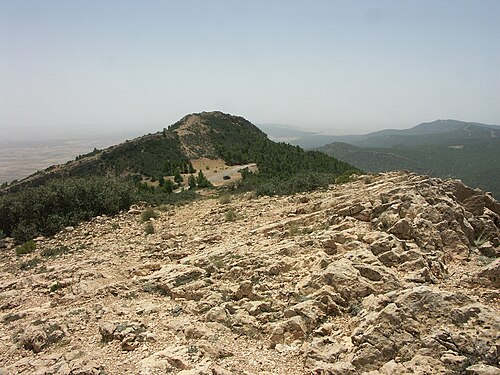
- Map Locations: Google Maps | OpenStreetMap